Introduction
How to achieve reliable, production-grade deployments with Kubernetes GitOps, Blue-Green, and Canary strategies
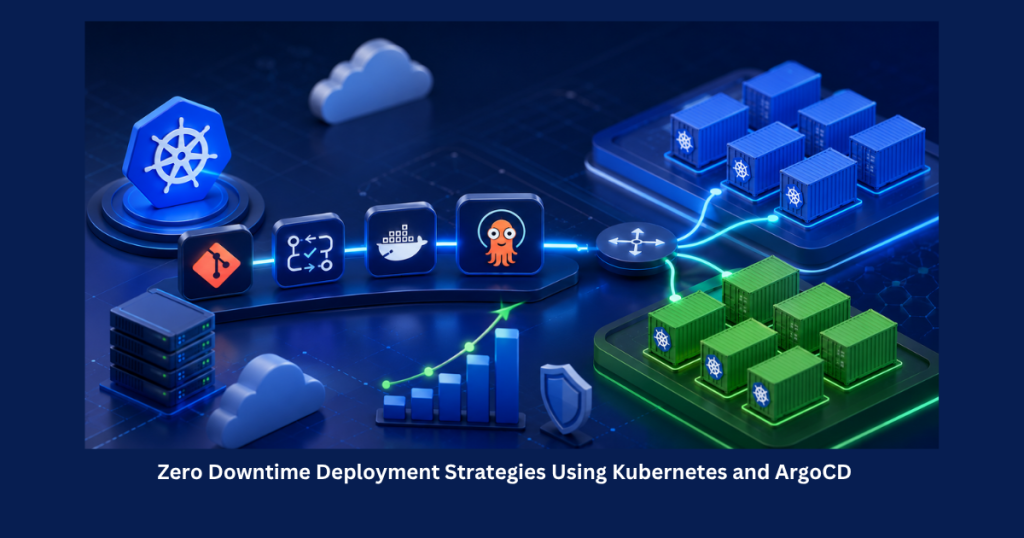
Zero downtime deployment in Kubernetes is achieved by combining rolling updates, health probes, traffic management, and GitOps automation with ArgoCD. The most reliable enterprise approaches are Blue-Green Deployment Kubernetes and Canary Deployment Kubernetes, where traffic is gradually shifted to a new version while the old version remains available.
Using Kubernetes Deployment Strategies with ArgoCD Deployment allows teams to automate releases, reduce deployment failures, and achieve near-zero service interruption.
Why Zero Downtime Deployments Matter
Every minute of downtime can result in lost revenue, failed transactions, and damaged customer trust. For fintech platforms, SaaS products, e-commerce applications, and APIs, deployment reliability is often more important than deployment speed.
Common deployment problems
- Pods terminate before new pods are ready
- Database migrations break backward compatibility
- Load balancers route traffic to unhealthy pods
- Configuration drift between environments
- Manual deployments introduce human error
Core Kubernetes Deployment Strategies
1. Rolling Update (Default Kubernetes Strategy)
Kubernetes gradually replaces old pods with new ones.
Best for
- Stateless applications
- Microservices
- Low-risk releases
Example configuration
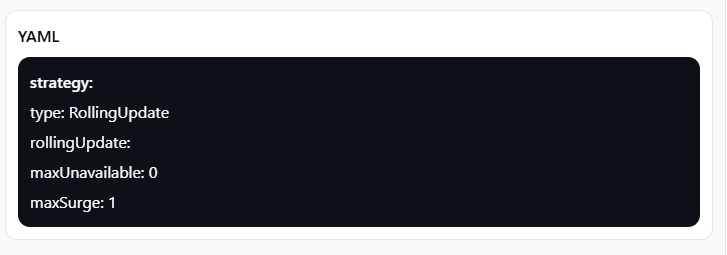
Key setting: maxUnavailable: 0 ensures Kubernetes never reduces available capacity during deployment.
2. Blue-Green Deployment Kubernetes
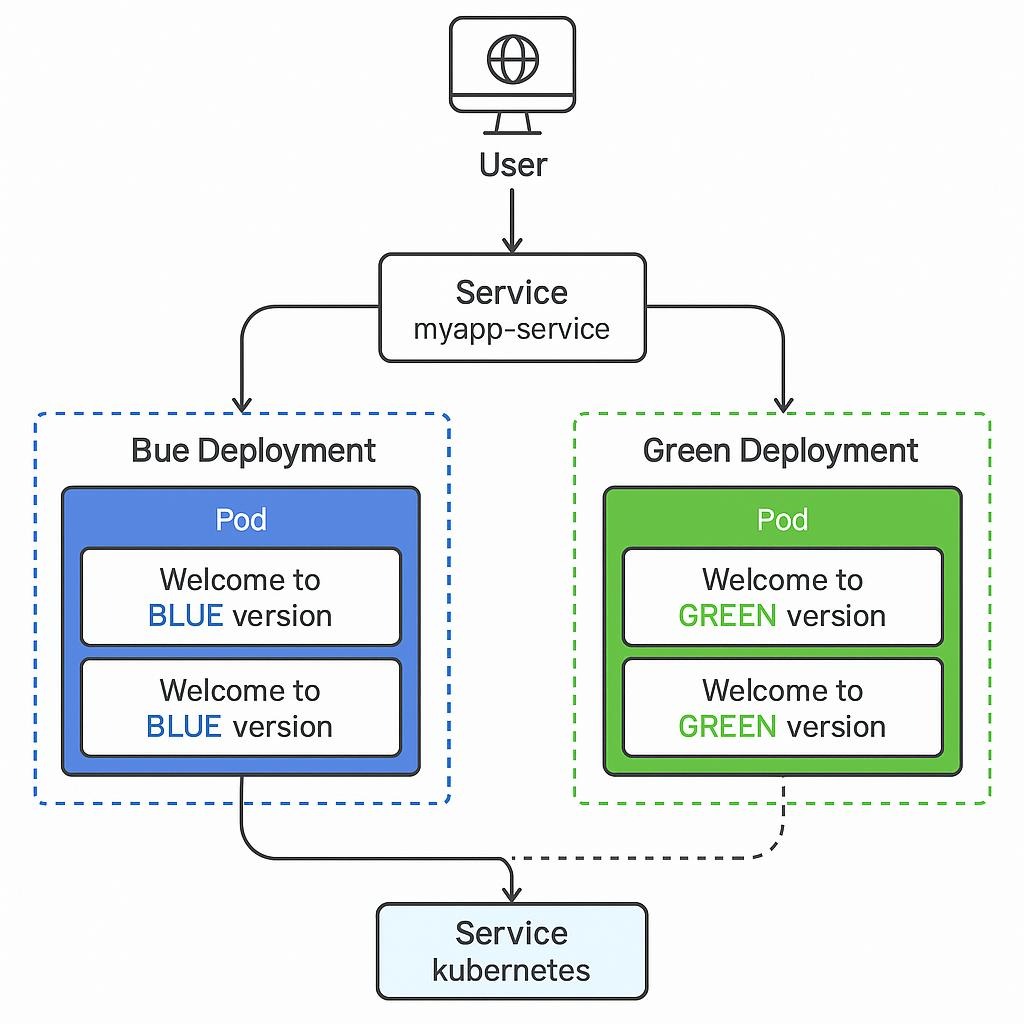
Blue-Green Deployment Kubernetes maintains two identical environments:
- Blue = current production
- Green = new version
Traffic switches to Green only after validation.
Advantages:
- Instant rollback
- Full production testing
- Near-zero downtime
- Safer for critical systems
Considerations:
- Requires double infrastructure capacity
- Database migration planning is essential
3. Canary Deployment Kubernetes
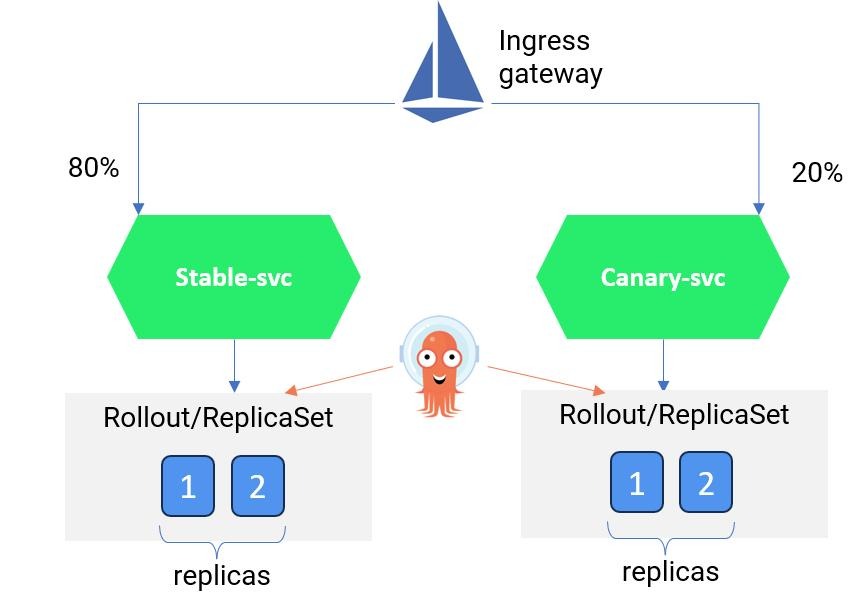
Canary Deployment Kubernetes releases the new version to a small percentage of users first.
| Stage | Traffic |
| Canary 1 | 5% |
| Canary 2 | 25% |
| Canary 3 | 50% |
| Production | 100% |
Ideal for
This approach is ideal for:
- High-traffic applications
- Feature validation
- Risk reduction
- A/B testing
How ArgoCD Enables Zero Downtime Deployments
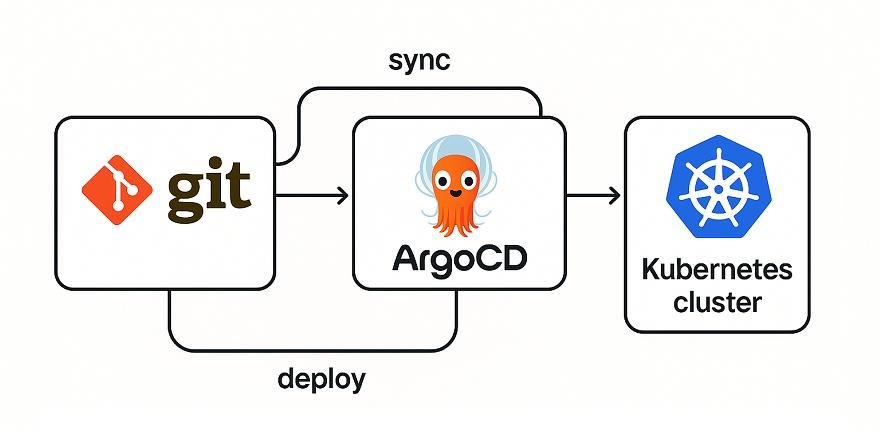
ArgoCD Deployment brings GitOps principles to Kubernetes.
GitOps Workflow
- Developer commits code.
- CI pipeline builds a container image.
- Git repository is updated with a new image tag.
- ArgoCD detects the Git change.
- ArgoCD synchronizes Kubernetes automatically.
- Health checks verify the rollout.
Best Practices for True Zero Downtime
Essential configuration checklist
- Readiness probes — Route traffic only to healthy pods.
- Liveness probes — Restart failed containers automatically.
- PodDisruptionBudgets — Prevent too many pods from being unavailable.
- Horizontal Pod Autoscaling — Maintain capacity during deployments.
- Progressive delivery — Use canary analysis before full rollout.
- Observability — Monitor latency, error rate, and saturation.
Real-World Case Study: Fintech Payment Platform
Challenge
A payment gateway processing thousands of transactions per minute.
Solution
- Kubernetes on Azure AKS
- ArgoCD for GitOps
- Canary deployments with traffic splitting
- Prometheus and Grafana monitoring
- Automated rollback on error-rate thresholds
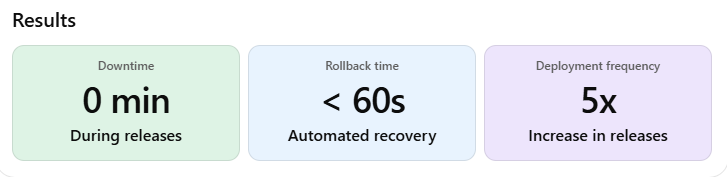
Results
Future Trends
The future of Kubernetes GitOps is moving toward:
- AI-assisted deployment analysis
- Automated canary scoring
- Policy-driven GitOps
- Multi-cluster progressive delivery
- Security-aware deployment pipelines
Final Verdict
Zero downtime is not a single Kubernetes feature, it is a deployment discipline. Organizations that combine Kubernetes Deployment Strategies, ArgoCD Deployment, health checks, progressive delivery, and GitOps automation can release software continuously without interrupting customers.
Ready to Modernize Your Kubernetes Deployments?
If your team is still performing manual releases or experiencing deployment-related outages, the fastest path to reliability is a production-grade GitOps platform with automated rollback, canary analysis, and observability built in.
A well-designed Kubernetes deployment architecture can reduce release risk, improve developer velocity, and help your business deploy multiple times per day with confidence.
Frequently Asked Questions
Zero downtime deployment using Kubernetes and ArgoCD is achieved by combining rolling updates, readiness and liveness probes, GitOps automation, and progressive deployment strategies such as Blue-Green or Canary deployments. ArgoCD continuously synchronizes Kubernetes clusters with Git repositories, ensuring safe, automated, and reversible deployments The best Kubernetes deployment strategy depends on your application requirements. Rolling Updates work well for most stateless applications, while Blue-Green Deployment Kubernetes offers instant rollback for mission-critical systems.Canary Deployment Kubernetes is ideal for gradually validating new releases with a subset of users before full production rollout. ArgoCD Deployment simplifies Kubernetes GitOps by treating Git as the single source of truth. It automates deployments, detects configuration drift, supports automatic rollback, improves security through version-controlled infrastructure, and enables consistent deployments across multiple Kubernetes clusters. Blue-Green Deployment Kubernetes provides immediate traffic switching and fast rollback by maintaining two identical production environments.Canary Deployment Kubernetes gradually shifts traffic to the new version, allowing teams to monitor application performance and detect issues before releasing to all users. The right choice depends on your application's risk tolerance and infrastructure capacity. Organizations should consider Kubernetes Deployment Services when managing production Kubernetes clusters, implementing GitOps workflows, migrating legacy applications, automating CI/CD pipelines, or requiring zero downtime deployments. Expert Kubernetes consultants help reduce deployment failures, improve application availability, and accelerate software delivery while following cloud-native best practices.1. How do you achieve zero downtime deployment using Kubernetes and ArgoCD?
2. What is the best Kubernetes deployment strategy for production applications?
3. Why should enterprises use ArgoCD for Kubernetes GitOps deployments?
4. What are the benefits of Blue-Green Deployment Kubernetes compared to Canary Deployment?
5. When should businesses invest in professional Kubernetes Deployment Services?