Table of Contents
Amazon ECR vs GitHub Actions, and where each one actually fits
A GitHub Actions workflow can build, test, and deploy a Docker image automatically but it doesn’t replace the container registry your application needs. For teams running workloads on Amazon EKS, choosing the right registry affects security, authentication, image delivery, and operational complexity.
So, do you need Amazon ECR for Amazon EKS deployments? Not technically. EKS can pull images from ECR, GitHub Container Registry (GHCR), Docker Hub, or any other OCI-compatible registry. But for production workloads running primarily on AWS, ECR gives you a level of integration with AWS identity, security, and infrastructure that’s hard to match.
GitHub Actions and Amazon ECR solve different problems
One of the most common misunderstandings is treating GitHub Actions and Amazon ECR as competing services. They aren’t.
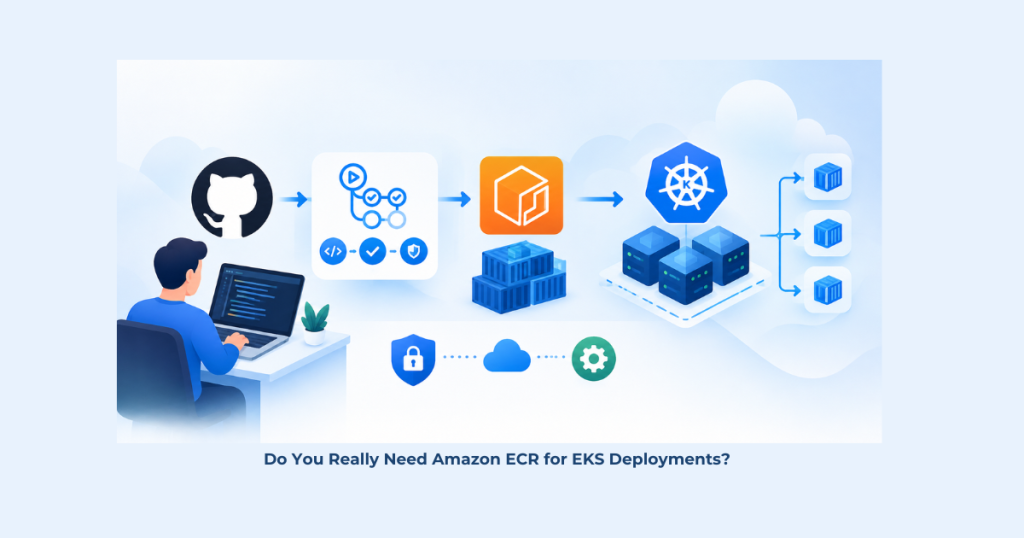
GitHub Actions is the automation layer that runs your CI/CD pipeline; it builds Docker images, runs tests and security checks, and deploys applications. Amazon ECR is the container image registry that stores the images that pipeline produces. A typical Kubernetes CI/CD workflow puts them in sequence, not in competition:
Developer pushes code
↓ GitHub Actions
↓ Build & test application
↓ Build Docker image
↓ Amazon ECR
↓ Amazon EKS
↓ Kubernetes deployment
↓ Health check & rollout
Keeping these as separate components rather than expecting one to absorb the other’s job is what makes the architecture easy to reason about and extend.
What ECR actually gives an EKS workload
Using Amazon ECR as the image repository for an EKS workload keeps the process straightforward: GitHub Actions builds the image, the workflow authenticates with AWS, the image gets pushed to an ECR repository, EKS pulls the image it needs, and Kubernetes starts or updates the containers. Nothing about the CI/CD system and the image registry gets treated as the same component.
The advantages that come with it are concrete rather than theoretical:
- AWS-native authentication — ECR works directly with IAM-based access controls, so there’s no separate credential to create and rotate
- Security integration — built-in image scanning and encryption
- Lifecycle management — policies to automatically clean up older images
- Native AWS integration — ECR works naturally with EKS and the rest of the AWS ecosystem
- Private registry support — images stay inside an AWS-controlled environment rather than a public registry
For production EKS environments, these integrations tend to reduce day-to-day operational overhead rather than add to it.
Amazon ECR vs GitHub Container Registry
Both ECR and GHCR can store the container images Kubernetes pulls from. The better choice depends on your infrastructure, your security requirements, and how your team already works, not simply on which registry is technically capable of the job.
| Requirement | Amazon ECR | GitHub Container Registry |
| AWS-native EKS environment | Strong fit | Supported |
| GitHub ecosystem integration | Good | Strong |
| IAM-based AWS access control | Yes | No |
| Private container images | Yes | Yes |
| Image scanning | Yes | Available via GitHub security features |
| AWS service integration | Strong | Limited |
| Multi-cloud flexibility | Good | Good |
| Open-source project workflow | Suitable | Strong fit |
Use Amazon ECR when your production workloads run on AWS, EKS is your primary Kubernetes platform, you want IAM integration and centralized image governance, or security and compliance requirements matter. GHCR makes more sense when your workflow is heavily centered on GitHub already, you maintain open-source projects, you operate across multiple cloud providers, or the environment in question is genuinely temporary.
| Use Case | Suitable Choice |
| Production Amazon EKS | Amazon ECR |
| AWS-focused workloads | Amazon ECR |
| Temporary testing environment | GHCR can be suitable |
| Open-source project | GHCR can be suitable |
| Multi-cloud Kubernetes | GHCR or another vendor-neutral registry |
| AWS security and IAM integration | Amazon ECR |
| Long-term EKS staging environment | Amazon ECR |
That table makes the decision simpler than it first appears: choose the registry based on your runtime environment, security model, and operational requirements not on which CI/CD platform happens to be running the pipeline.
Deploying Docker images to EKS with GitHub Actions
A standard GitHub Actions pipeline to EKS follows a familiar shape. A developer pushes code, which triggers the workflow. The pipeline runs tests and security checks before anything gets built for production. GitHub Actions then builds an immutable image tagged with the commit SHA never a mutable tag like “latest” for example:
docker build -t <account-id>.dkr.ecr.ap-south-1.amazonaws.com/app:$GITHUB_SHA .
The workflow authenticates with AWS and pushes that image to ECR:
docker push <account-id>.dkr.ecr.ap-south-1.amazonaws.com/app:$GITHUB_SHA
Tagging by commit SHA matters here it ties a running container back to an exact source revision, so there’s never any ambiguity about what’s actually deployed. From there, the workflow updates the Kubernetes deployment:
kubectl set image deployment/app \
app=<account-id>.dkr.ecr.ap-south-1.amazonaws.com/app:$GITHUB_SHA
and Kubernetes checks whether the new pods come up healthy. If the rollout fails, the pipeline can trigger a rollback to the previous known-good version automatically. That’s a repeatable deployment process instead of a manual, SSH-based one.
Our own experience building this
The architecture in this article comes out of a real EKS CI/CD build, not a theoretical example. For a lean staging environment, the setup included an EKS cluster in the Mumbai region, a worker node sized for the application workload, controlled administrative access through a bastion host, Amazon ECR for the container images, and GitHub Actions running the CI/CD automation following a simple path from GitHub repository, through GitHub Actions, to a Docker image, into ECR, and out to EKS.
The workflow also included rollout validation, so a failed deployment gets caught rather than left running unnoticed. The lesson that came out of it was architectural more than technical: GitHub Actions and ECR are complementary, not overlapping. Actions runs the automation; ECR gives EKS a managed place to pull the resulting images from. Keeping those responsibilities separate is what makes the setup easy to extend as it moves from proof-of-concept toward production.
Security considerations worth building in early
A production-ready CI/CD workflow needs to think about more than just pushing an image. A few controls are worth treating as non-negotiable from the start:
- Use GitHub Actions OIDC with AWS IAM instead of long-lived AWS access keys
- Avoid mutable tags such as “latest” for production deployments
- Tag images uniquely by commit SHA or release version
- Scan images for known vulnerabilities before they ship
- Apply least-privilege IAM permissions throughout the pipeline
- Restrict who can push and pull production images
- Configure ECR lifecycle policies to clear out old, unused images
- Monitor deployment and application health after every rollout
None of these are exotic, but skipping them is exactly how container supply-chain and credential risks creep into an otherwise solid pipeline.
Where container registries are headed
The role of a container registry is expanding well past simple image storage. Teams are increasingly building toward software bills of materials (SBOMs), image signing, provenance and attestation, automated vulnerability scanning, policy-based deployment controls, short-lived cloud credentials, and automated supply-chain verification.
As Kubernetes adoption grows, knowing exactly where an image came from, whether it’s been modified, and whether it meets security policy before deployment is becoming table stakes rather than a nice-to-have which is exactly why the integration between ECR, IAM, EKS, and CI/CD tooling matters more each year for AWS-centric environments.
The takeaway
The question was never whether GitHub Actions can replace Amazon ECR it can’t, because they serve different purposes. GitHub Actions provides the automation to build, test, and deploy applications. Amazon ECR provides a managed registry where those images can be securely stored and retrieved by EKS.
For AWS-focused production environments, ECR offers a practical combination of AWS integration, IAM-based access control, and operational simplicity. If you’re standing up in a temporary development environment, GHCR is perfectly adequate. If you’re building a long-term production or staging platform on AWS, ECR gives you a more consistent path from development through to production. The real goal is designing the pipeline, the registry, the identity model, and the Kubernetes environment as one connected architecture, not as isolated tools bolted together.
Building an EKS pipeline that’s ready for production?
A working deployment pipeline is only the starting point; the bigger challenge is making it secure, repeatable, observable, and easy to operate as the application grows. If you’re planning an EKS migration or reviewing an existing Kubernetes CI/CD setup, our AWS and DevOps team can help assess your current architecture, identify deployment and security gaps, and design a production-ready pipeline using GitHub Actions, Amazon ECR, IAM, and EKS. Reach out for a free consultation.
Frequently Asked Questions:
No, Amazon ECR is not mandatory for Amazon EKS deployments. However, Amazon ECR for Amazon EKS deployments is often preferred for AWS production workloads because it integrates with AWS IAM, security controls, and other AWS services. Yes. A GitHub Actions CI/CD pipeline for Amazon EKS can build and test a Docker image, push it to a container registry such as Amazon ECR, and update the Kubernetes deployment on EKS. Amazon ECR is a Docker container registry, while GitHub Actions is a CI/CD automation platform. In an Amazon EKS deployment with Amazon ECR and GitHub Actions, GitHub Actions builds and deploys the application while ECR stores the container image. For AWS-focused production environments, Amazon ECR vs GitHub Container Registry for EKS often comes down to integration and operational requirements. ECR provides native AWS integration and IAM-based access control, while GHCR is closely integrated with the GitHub ecosystem. To deploy Docker images to Amazon EKS using GitHub Actions, configure the workflow to authenticate with AWS, build the Docker image, push it to Amazon ECR, update the EKS deployment, and verify the Kubernetes rollout.1. Do you need Amazon ECR for Amazon EKS deployments?
2. Can GitHub Actions deploy directly to Amazon EKS?
3. What is the difference between Amazon ECR and GitHub Actions?
4. Is Amazon ECR better than GitHub Container Registry for EKS?
5. How do you deploy Docker images to Amazon EKS using GitHub Actions?
Authod Details:
Santosh Mhaske
Technical Lead - Senior DevOps Engineer