In today’s digital-first economy, a single minute of downtime can cost businesses thousands of dollars in lost revenue, damaged reputation, and customer dissatisfaction. According to industry reports, unplanned IT downtime can cost enterprises over $9,000 per minute, while nearly 60% of outages are linked to infrastructure issues that could have been detected earlier.
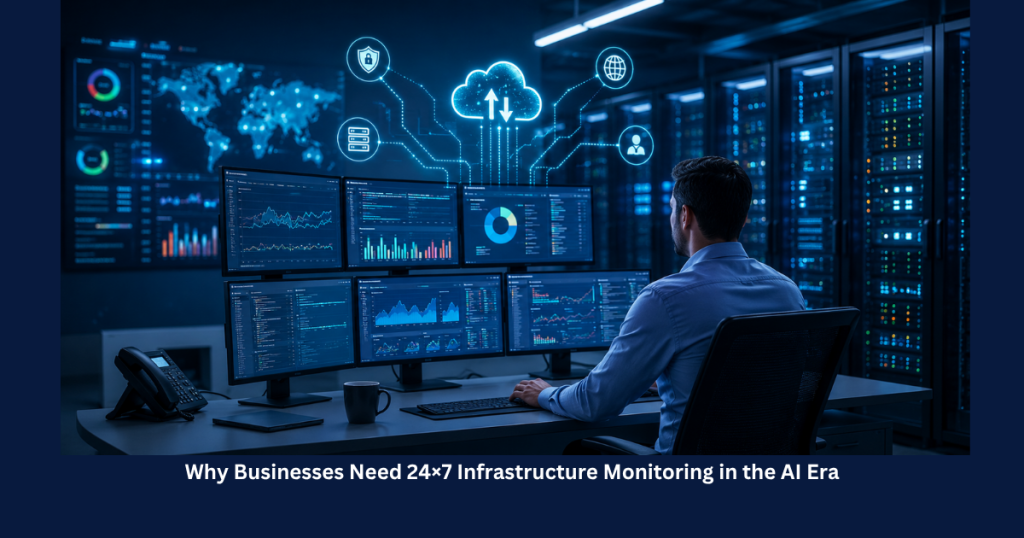
24×7 Infrastructure Monitoring is no longer an optional IT function; it is a business-critical strategy that ensures servers, networks, cloud resources, applications, and databases remain available, secure, and optimized around the clock.
What Is 24×7 Infrastructure Monitoring?
24×7 Infrastructure Monitoring is the continuous observation, analysis, and management of IT infrastructure components to detect performance issues, security threats, failures, and resource bottlenecks before they impact business operations.
It combines Real-Time Server Monitoring, automated alerting, incident response, performance analytics, and proactive maintenance to ensure maximum uptime and operational efficiency.
Why Businesses Need 24×7 Infrastructure Monitoring
Modern organizations rely heavily on cloud platforms, AI-driven applications, remote workforces, and always-on digital services. Even a short disruption can affect customers, employees, and revenue streams.
Key Challenges Businesses Face
Without continuous monitoring, organizations often experience:
- Unexpected server crashes
- Slow application performance
- Network bottlenecks
- Security vulnerabilities
- Resource overutilization
- Cloud cost inefficiencies
- Delayed incident response
These issues can quickly escalate into major outages when left undetected.
Why It Matters
Businesses today operate in an environment where customers expect:
- 24/7 service availability
- Fast application response times
- Secure digital experiences
- Consistent performance across regions
A proactive monitoring strategy ensures these expectations are consistently met.
The Growing Importance of AI Infrastructure Monitoring
The rise of artificial intelligence has introduced new infrastructure demands.
AI workloads require:
- High-performance computing resources
- GPU-intensive environments
- Massive data processing capabilities
- Real-time analytics
- Continuous resource optimization
This makes AI Infrastructure Monitoring essential for organizations deploying machine learning models, generative AI applications, and intelligent automation systems.
Benefits of AI Infrastructure Monitoring
Organizations can:
- Detect resource saturation early
- Monitor GPU and CPU utilization
- Prevent model performance degradation
- Optimize infrastructure costs
- Improve AI application availability
As AI adoption grows, infrastructure visibility becomes a competitive advantage.
Benefits of 24×7 Server Monitoring Services
1. Reduced Downtime
Continuous monitoring identifies issues before they become outages.
Proactive alerts allow IT teams to:
- Resolve incidents faster
- Prevent service disruptions
- Minimize revenue loss
2. Faster Incident Response
Modern Server Monitoring and Incident Response Services provide immediate notifications when anomalies occur.
This enables teams to:
- Investigate root causes quickly
- Reduce Mean Time to Resolution (MTTR)
- Improve service reliability
3. Enhanced Security
Infrastructure monitoring helps detect:
- Unauthorized access attempts
- Suspicious network activity
- Resource abuse
- Malware-related behavior
Early detection significantly reduces security risks.
4. Improved Performance
Infrastructure Performance Monitoring provides visibility into:
- CPU utilization
- Memory consumption
- Disk performance
- Network latency
- Application response times
This helps businesses optimize resources before users experience slowdowns.
5. Better Customer Experience
Reliable systems directly contribute to:
- Faster websites
- Better application responsiveness
- Increased customer trust
- Higher retention rates
How 24×7 Infrastructure Monitoring Works
Understanding the monitoring process helps organizations appreciate its value.
Step 1: Continuous Data Collection
Monitoring tools gather metrics from:
- Servers
- Cloud instances
- Databases
- Networks
- Applications
Step 2: Real-Time Analysis
Collected data is analyzed continuously to identify:
- Performance degradation
- Resource spikes
- Security anomalies
- Service interruptions
Step 3: Automated Alerts
When thresholds are exceeded, alerts are sent through:
- SMS
- Slack
- Ticketing systems
Step 4: Incident Response
Monitoring teams investigate and resolve issues before they impact users.
Step 5: Optimization and Reporting
Long-term trends help organizations:
- Improve infrastructure efficiency
- Forecast capacity needs
- Reduce operational costs
Real-World Use Cases
E-Commerce Platforms
An online retailer experiences a sudden traffic surge during a seasonal sale.
Using Real-Time Server Monitoring, infrastructure teams detect CPU spikes early and scale resources automatically, preventing website crashes.
SaaS Companies
A SaaS provider relies on Managed Infrastructure Monitoring Services for Enterprises to ensure global application availability.
Monitoring detects database latency issues before customers notice performance degradation.
AI-Powered Businesses
Organizations running AI models use AI Infrastructure Monitoring to track GPU utilization and optimize machine learning workloads.
This prevents expensive resource waste and model downtime.
Financial Services
Banks and fintech companies use 24×7 Server Monitoring Services to maintain compliance, detect suspicious activity, and ensure uninterrupted transactions.
Statistics That Highlight the Need for Continuous Monitoring
Several industry findings reinforce the importance of proactive infrastructure management:
- Gartner reports that the average cost of IT downtime can reach thousands of dollars per minute for large enterprises.
- Studies show that nearly 90% of organizations experience at least one infrastructure-related outage annually.
- Research indicates that proactive monitoring can reduce incident resolution times by more than 50%.
These numbers demonstrate why businesses are investing heavily in continuous monitoring solutions.
Best Practices for Effective Infrastructure Monitoring
Establish Clear Performance Baselines
Understand normal system behavior to identify anomalies quickly.
Monitor the Entire Technology Stack
Include:
- Servers
- Applications
- Databases
- Cloud services
- Network devices
Use Intelligent Alerting
Avoid alert fatigue by prioritizing critical events.
Automate Incident Response
Automation accelerates resolution and reduces manual intervention.
Conduct Regular Infrastructure Reviews
Analyze monitoring reports to identify recurring issues and improvement opportunities.
Partner with Experts
Many organizations benefit from Managed Infrastructure Services that provide around-the-clock expertise and monitoring support.
Future Trends in Infrastructure Monitoring
The future of monitoring is increasingly intelligent and predictive.
AI-Driven Observability
Advanced platforms are using machine learning to predict failures before they occur.
Predictive Maintenance
Organizations can address infrastructure issues before they impact performance.
Cloud-Native Monitoring
Demand for 24×7 Infrastructure Monitoring for Cloud Environments continues to grow as businesses migrate workloads to multi-cloud ecosystems.
Autonomous Incident Response
AI-powered systems are beginning to resolve common issues automatically without human intervention.
Unified Visibility Platforms
Businesses are adopting centralized dashboards that provide complete infrastructure visibility across hybrid environments.
Final Verdict
The AI era has transformed infrastructure from a back-office IT function into a strategic business asset. Organizations that lack continuous visibility into their systems face higher risks of downtime, security incidents, performance degradation, and operational inefficiencies.
Investing in 24×7 Infrastructure Monitoring, Infrastructure Performance Monitoring, and Managed Infrastructure Monitoring Services for Enterprises enables businesses to stay resilient, scalable, and competitive in an increasingly digital world.
Turn Infrastructure Visibility Into Business Growth
Don’t wait for outages, performance issues, or security incidents to expose hidden weaknesses in your IT environment. Implement enterprise-grade 24×7 Server Monitoring Services that identify problems before customers notice them, optimize performance around the clock, and keep critical business operations running without interruption.
Partner with infrastructure experts who provide proactive monitoring, rapid incident response, and continuous optimization so your team can focus on innovation while your infrastructure stays secure, available, and ready for growth.
Frequently Asked Questions
Q1. Why do businesses need 24×7 infrastructure monitoring for cloud environments?
A: Businesses need 24×7 infrastructure monitoring for cloud environments to detect performance issues, resource bottlenecks, and security threats in real time. Continuous monitoring helps maintain uptime, improve cloud efficiency, and prevent costly outages.
Q2. What are the benefits of 24×7 server monitoring services for enterprises?
A: The primary benefits of 24×7 server monitoring services for enterprises include reduced downtime, faster incident response, improved security, optimized resource utilization, and enhanced customer experience through uninterrupted service availability.
Q3. How do managed infrastructure monitoring services help growing businesses?
A: Managed infrastructure monitoring services for enterprises provide round-the-clock oversight, expert incident management, proactive maintenance, and performance optimization, allowing internal teams to focus on strategic business initiatives.
Q4. What is the role of AI infrastructure monitoring in modern IT operations?
A: AI infrastructure monitoring solutions for modern businesses help track GPU performance, server health, workload distribution, and resource consumption, ensuring AI applications run efficiently without performance degradation.
Q5. How do server monitoring and incident response services reduce downtime?
A: Server monitoring and incident response services identify anomalies, trigger real-time alerts, and enable rapid remediation before users are impacted. This proactive approach significantly reduces downtime and improves operational reliability.