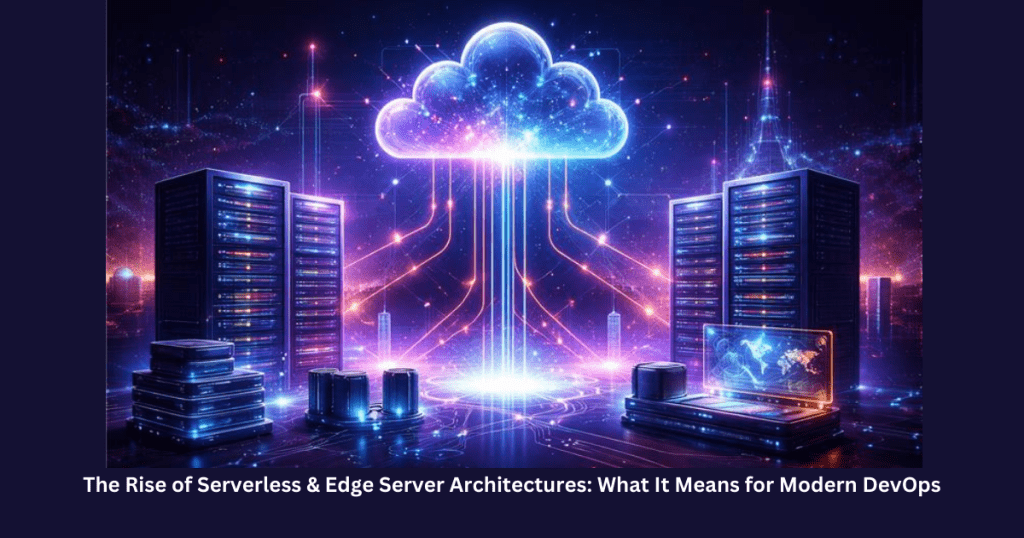
Infrastructure is no longer confined to data centers or even centralized cloud regions. Over the past few years, Serverless Computing, Edge Computing, and Event-Driven Architecture have reshaped how modern applications are built, deployed, and scaled.
For DevOps teams, this isn’t just another trend — it’s a fundamental shift in infrastructure management, deployment automation, observability, and cost optimization.
In this blog, we’ll explore how these technologies are transforming modern DevOps practices, the business impact behind them, and how organizations can adapt to stay competitive.
Why Traditional Infrastructure Is No Longer Enough
A decade ago, managing infrastructure meant provisioning VMs, configuring load balancers, and maintaining scaling rules manually. Even with cloud platforms like Amazon Web Services, Microsoft Azure, and Google Cloud, teams still managed servers — just virtually.
But modern digital products demand:
- Real-time responsiveness
- Global low-latency access
- Automatic scaling
- Cost efficiency at scale
- Faster feature releases
This is where Serverless Computing and Edge Server Architectures enter the picture.
According to industry reports, serverless adoption has grown significantly over the past five years, with many enterprises running production workloads on services like AWS Lambda and Azure Functions.
The shift is clear: infrastructure management is becoming abstracted, automated, and event-driven.
What Is Serverless Computing?
Despite the name, servers still exist — but developers don’t manage them.
Serverless Computing allows teams to run code in response to events without provisioning or maintaining servers. Cloud providers handle scaling, patching, availability, and capacity planning.
Key Characteristics:
- Event-triggered execution
- Automatic scaling
- Pay-per-execution pricing
- No server management
- Built-in high availability
Popular examples include:
- AWS Lambda
- Azure Functions
- Google Cloud Functions
Why DevOps Teams Are Embracing Serverless
1. Infrastructure as Code Becomes Simpler
Instead of managing clusters and instances, DevOps engineers define triggers, permissions, and integrations.
2. Reduced Operational Overhead
No OS patching. No scaling rules tuning. No capacity estimation.
3. Faster Deployment Cycles
Functions deploy in seconds, accelerating CI/CD pipelines.
4. Cost Optimization
You only pay when your function runs — ideal for unpredictable workloads.
Real-World Example
An e-commerce platform running flash sales can handle sudden traffic spikes automatically without pre-provisioning infrastructure. When traffic drops, costs drop too.
The Rise of Edge Computing
If serverless removed infrastructure headaches, Edge Computing removes latency.
Instead of processing data in centralized cloud regions, edge computing processes it closer to users at distributed edge locations.
Content delivery networks (CDNs) and edge platforms like Cloudflare and Fastly now allow developers to deploy logic at edge nodes worldwide.
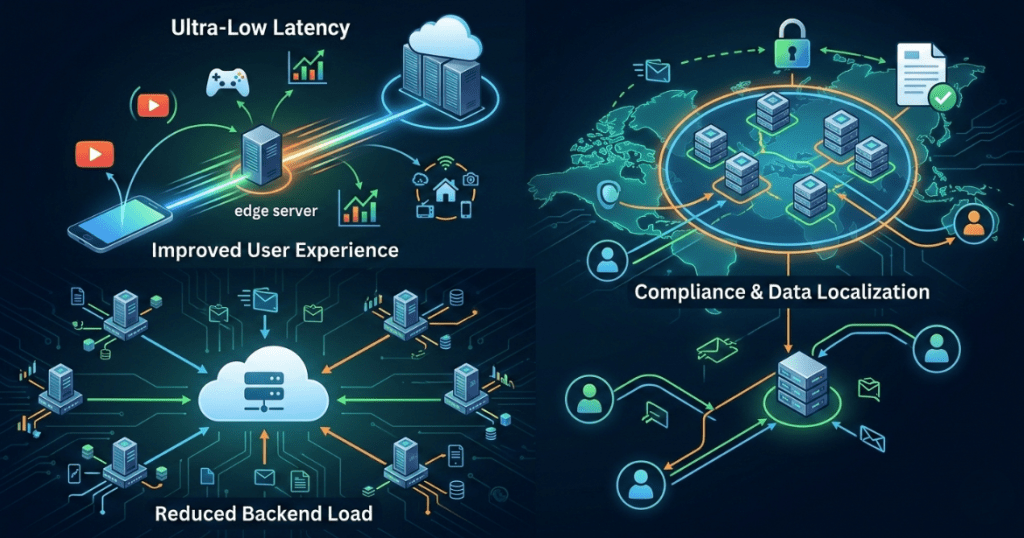
Why Edge Architectures Matter
1. Ultra-Low Latency
Applications load faster because data travels shorter distances.
2. Improved User Experience
Critical for:
- Streaming platforms
- Online gaming
- Financial trading apps
- IoT systems
3. Better Compliance & Data Localization
Edge deployments can help meet regional data regulations.
4. Reduced Backend Load
Processing at the edge reduces central cloud consumption.
Event-Driven Architecture: The Glue That Connects It All
Serverless and edge systems thrive on Event-Driven Architecture.
Instead of monolithic applications, services react to events:
- A file upload
- A payment confirmation
- A user login
- A sensor trigger
Message brokers and streaming platforms like Apache Kafka play a major role in enabling real-time event streaming.
Benefits of Event-Driven DevOps
- Loose coupling between services
- Improved scalability
- Resilient microservices
- Real-time data processing
- Better fault isolation
For DevOps, this means designing infrastructure around events rather than servers.
How This Shift Impacts Modern DevOps Practices
The move toward Serverless Computing and Edge Server Architectures fundamentally changes DevOps workflows.
1. CI/CD Pipelines Become More Modular
Instead of deploying full applications:
- Teams deploy independent functions
- Canary releases become easier
- Rollbacks are faster
Infrastructure as Code tools integrate directly with serverless frameworks.
2. Observability Becomes Critical
In distributed systems:
- Failures are harder to trace
- Logs are fragmented
- Cold starts affect performance
DevOps teams now prioritize:
- Distributed tracing
- Centralized logging
- Real-time monitoring
3. Security Shifts Left
Serverless increases the attack surface via:
- Function permissions
- API gateways
- Event triggers
Modern DevSecOps focuses on:
- Least-privilege IAM policies
- Runtime security monitoring
- Automated vulnerability scanning
4. FinOps Gains Importance
While serverless reduces idle costs, poor architecture can increase execution costs.
Key optimization strategies:
- Memory tuning
- Reducing function duration
- Avoiding unnecessary triggers
- Monitoring invocation frequency
Smart FinOps practices align usage with business value.
Business Impact: Why Enterprises Are Moving Fast
Organizations adopting serverless and edge architectures report:
- Faster time-to-market
- Reduced infrastructure management costs
- Improved global performance
- Better scalability for unpredictable demand
Industries seeing strong adoption:
- FinTech
- E-commerce
- SaaS platforms
- Media streaming
- IoT ecosystems
For example, streaming platforms leverage edge caching and event-driven systems to deliver content globally with minimal buffering.
Challenges to Consider
Despite the benefits, there are trade-offs.
1. Vendor Lock-In
Heavy reliance on specific cloud-native services can reduce portability.
2. Cold Start Latency
Some serverless platforms introduce startup delays.
3. Debugging Complexity
Distributed event systems are harder to trace.
4. Skill Gaps
Teams must learn new architectural patterns.
Modern DevOps must evolve from “server managers” to “system orchestrators.”
Future Trends in Serverless & Edge DevOps
The next evolution includes:
- Edge AI inference
- Serverless Kubernetes
- Hybrid edge-cloud orchestration
- 5G-enabled distributed applications
- Multi-cloud event streaming
Cloud-native ecosystems continue to mature, enabling faster innovation cycles.
Strategic Roadmap for DevOps Leaders
To adopt Serverless Computing and Edge Server Architectures effectively:
Step 1: Identify Suitable Workloads
Start with:
- APIs
- Background jobs
- Event processing
- Static site hosting
Step 2: Implement Observability Early
Invest in monitoring before scaling.
Step 3: Apply Cost Governance
Track invocation patterns and execution times.
Step 4: Train Teams
Encourage cloud-native architectural thinking.
Step 5: Adopt Incrementally
Modernization doesn’t require a full rewrite.
Conclusion
The rise of Serverless Computing, Edge Computing, and Event-Driven Architecture signals a major transformation in how infrastructure is built and managed.
Modern DevOps is no longer about maintaining servers — it’s about designing resilient, automated, globally distributed systems.
Organizations that adapt early gain:
- Competitive agility
- Cost efficiency
- Better scalability
- Faster innovation cycles
The future of infrastructure is distributed, automated, and event-driven — and DevOps is at the center of this transformation.
Ready to modernize your infrastructure?
Start adopting Serverless Computing, Edge Architectures, and Event-Driven Design today to build faster, scale smarter, and innovate without limits.
The future of DevOps isn’t coming , it’s already here. Are you ready to lead it?
Frequently Asked Questions:
Serverless computing allows DevOps teams to deploy applications without managing servers. Cloud providers automatically handle scaling, availability, and infrastructure maintenance. Edge computing processes data closer to end users, reducing latency and improving application responsiveness globally. It is a software design pattern where services communicate through events, enabling real-time processing and scalable microservices. For variable or unpredictable workloads, serverless is often more cost-efficient because you pay only for actual execution time. It enables faster deployments, modular releases, and simplified rollbacks, improving overall DevOps agility.1. What is Serverless Computing in DevOps?
2. How does Edge Computing improve performance?
3. What is Event-Driven Architecture?
4. Is serverless more cost-effective than traditional cloud infrastructure?
5. How does serverless impact CI/CD pipelines?