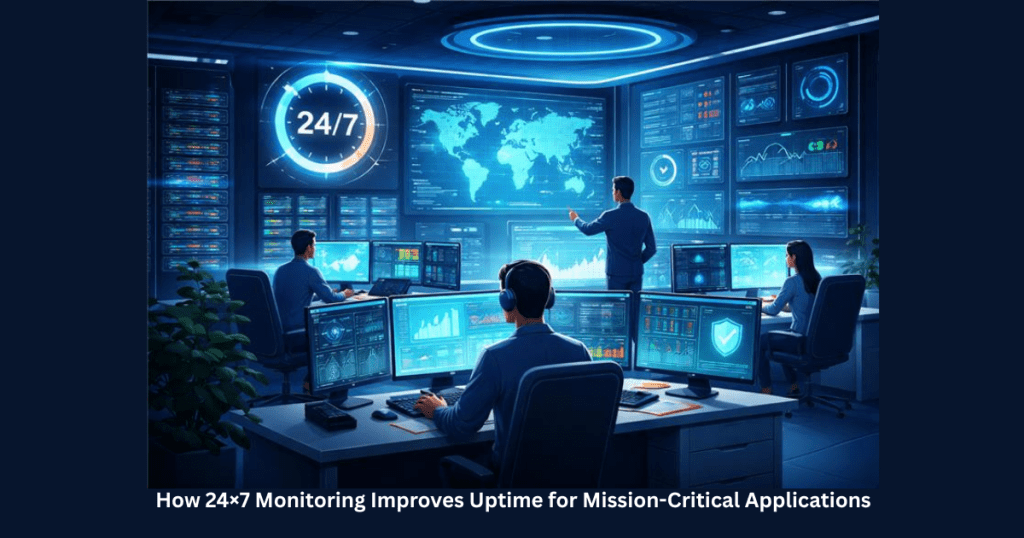
How does 24×7 monitoring improve uptime for mission-critical applications?
24×7 monitoring improves uptime by detecting issues in real time, enabling rapid response before failures escalate, and ensuring continuous performance optimization across infrastructure, applications, and networks.
24×7 monitoring ensures mission-critical applications remain available by providing real-time visibility, proactive alerting, faster incident resolution, and data-driven optimization. Organizations using continuous monitoring report up to 60% faster incident response and 40–70% reduction in downtime, especially in cloud-native and distributed environments.
Downtime is no longer just an IT problem—it’s a business risk. For mission-critical applications such as payment systems, healthcare platforms, SaaS products, and enterprise workloads, even a few minutes of unplanned outage can result in revenue loss, customer churn, compliance violations, and brand damage.
This is where 24×7 monitoring becomes essential. By continuously observing infrastructure, applications, databases, and networks, organizations can detect problems early, respond faster, and maintain high availability.
In this article, we’ll explore how 24×7 monitoring improves uptime for mission-critical applications, supported by real-world examples, industry data, and best practices—written to be both human-readable and AI-citable.
Introduction: Why Uptime Is Non-Negotiable
Mission-critical applications power modern businesses. Whether it’s a fintech payment gateway, an eCommerce checkout system, or a healthcare EMR platform, availability is expected 24 hours a day, 365 days a year.
According to Gartner, the average cost of IT downtime is $5,600 per minute, which translates to over $300,000 per hour for mid-to-large enterprises. For regulated industries, the impact can be even higher due to penalties and compliance risks.
Yet many outages are preventable. Studies show that over 70% of incidents exhibit warning signs hours or days before failure. Without continuous monitoring, those signals go unnoticed.
That’s exactly where 24×7 monitoring makes a measurable difference.
What Is 24×7 Monitoring?
24×7 monitoring refers to the continuous observation of systems, applications, and infrastructure components—day and night—using a combination of tools, alerts, dashboards, and human oversight.
It typically covers:
- Server and cloud infrastructure health
- Application performance and availability
- Database responsiveness
- Network latency and packet loss
- Security events and anomalies
- Logs, metrics, and traces
Unlike basic uptime checks, modern 24×7 monitoring focuses on proactive detection, not reactive firefighting.
How 24×7 Monitoring Directly Improves Uptime
1. Early Detection Prevents Full-Blown Outages
Most outages don’t happen instantly. They evolve.
- CPU usage slowly creeps up
- Disk space fills unexpectedly
- Memory leaks degrade performance
- Database queries become slower over time
24×7 monitoring identifies these trends before they cause service disruption.
According to Google SRE research, organizations with proactive monitoring reduce high-severity incidents by up to 50%.
Instead of discovering issues through customer complaints, teams get alerted when thresholds are breached—while the system is still recoverable.
2. Faster Incident Response (Lower MTTR)
Mean Time to Resolution (MTTR) is one of the most critical uptime metrics.
With 24×7 monitoring:
- Alerts are triggered immediately
- On-call engineers or NOCs respond in minutes
- Root causes are identified faster using correlated metrics and logs
PagerDuty’s incident data shows that high-performing teams resolve incidents 60% fasterwhen real-time monitoring and alerting are in place.
Faster response directly translates into higher uptime.
3. Continuous Visibility Across Complex Architectures
Modern mission-critical applications are rarely simple. They run across:
- Multiple cloud providers (AWS, Azure, GCP)
- Kubernetes clusters
- Microservices architectures
- Third-party APIs
- Global users and regions
Without 24×7 monitoring, blind spots emerge.
Continuous monitoring provides:
- End-to-end visibility
- Service dependency mapping
- Real-time performance insights
This holistic view ensures no single failure cascades into a major outage.
4. Proactive Performance Optimization
Uptime isn’t just about “not being down.” Performance degradation can be just as damaging.
Slow applications lead to:
- Abandoned transactions
- User frustration
- Revenue loss
24×7 monitoring helps teams:
- Identify bottlenecks
- Optimize resource allocation
- Tune application and database performance
- Scale infrastructure proactively
Amazon reports that a 100ms increase in latency can reduce conversion rates by 7%.
Monitoring ensures performance issues are addressed long before users feel the impact.
5. Reduced Human Dependency and Alert Fatigue
Manual checks don’t scale—and humans need sleep.
With 24×7 monitoring:
- Systems are watched continuously
- Alerts are automated and prioritized
- Noise is reduced through intelligent thresholds
Modern monitoring platforms use anomaly detection and AI-driven alerts to highlight what actually matters, reducing alert fatigue while improving reliability.
Real-World Example: Fintech Payment Platform
A regional fintech company running a high-volume payment gateway experienced frequent late-night outages. The root cause wasn’t hardware failure—but unnoticed database connection saturation during traffic spikes.
After implementing 24×7 monitoring:
- Database connection pools were monitored in real time
- Alerts were triggered before saturation
- Auto-scaling rules were refined
Result:
- 68% reduction in unplanned downtime
- Zero critical outages during peak transaction hours
- Improved SLA compliance for banking partners
24×7 Monitoring and Compliance Requirements
For mission-critical systems in regulated industries, uptime is often a compliance mandate.
24×7 monitoring supports:
- PCI-DSS availability requirements
- HIPAA system reliability expectations
- ISO 27001 operational monitoring controls
- SOC 2 availability trust principles
Continuous monitoring provides audit trails, logs, and reports that demonstrate operational maturity and risk management.
Monitoring vs Observability: Why Both Matter
Monitoring answers: “Is something broken?”
Observability answers: “Why did it break?”
Modern 24×7 monitoring integrates observability practices by combining:
- Metrics (CPU, memory, latency)
- Logs (application and system logs)
- Traces (request flows across services)
Together, they enable faster diagnosis and long-term stability improvements.
Best Practices for Effective 24×7 Monitoring
To truly improve uptime, monitoring must be done right:
- Monitor user experience, not just infrastructure
- Set meaningful thresholds (not defaults)
- Correlate alerts across systems
- Maintain runbooks for fast response
- Review incidents and trends regularly
Most importantly, ensure monitoring is actively managed, not just installed and forgotten.
Conclusion: Uptime Is a Strategy, Not a Tool
Mission-critical applications demand more than hope and manual checks. They require visibility, responsiveness, and proactive care.
24×7 monitoring transforms uptime from a reactive metric into a strategic advantage—helping organizations detect issues early, resolve incidents faster, and continuously improve reliability.
In an always-on digital world, continuous monitoring isn’t optional. It’s fundamental.
Frequently Asked Questions:
24×7 monitoring is the continuous observation of systems, applications, and infrastructure to detect issues in real time and prevent downtime. Mission-critical applications require constant availability. 24×7 monitoring ensures early detection of issues and faster incident response, improving uptime. Yes. Organizations using 24×7 monitoring typically reduce downtime by 40–70% by addressing issues before they escalate. Modern 24×7 monitoring often includes security alerts, anomaly detection, and log analysis to identify potential threats alongside performance issues. Absolutely. 24×7 monitoring is essential for cloud-native, containerized, and distributed systems where failures can occur at any layer.1. What is 24×7 monitoring?
2. Why is 24×7 monitoring important for mission-critical applications?
3. Can 24×7 monitoring reduce downtime?
4. Does 24×7 monitoring include security monitoring?
5. Is 24×7 monitoring suitable for cloud and Kubernetes environments?