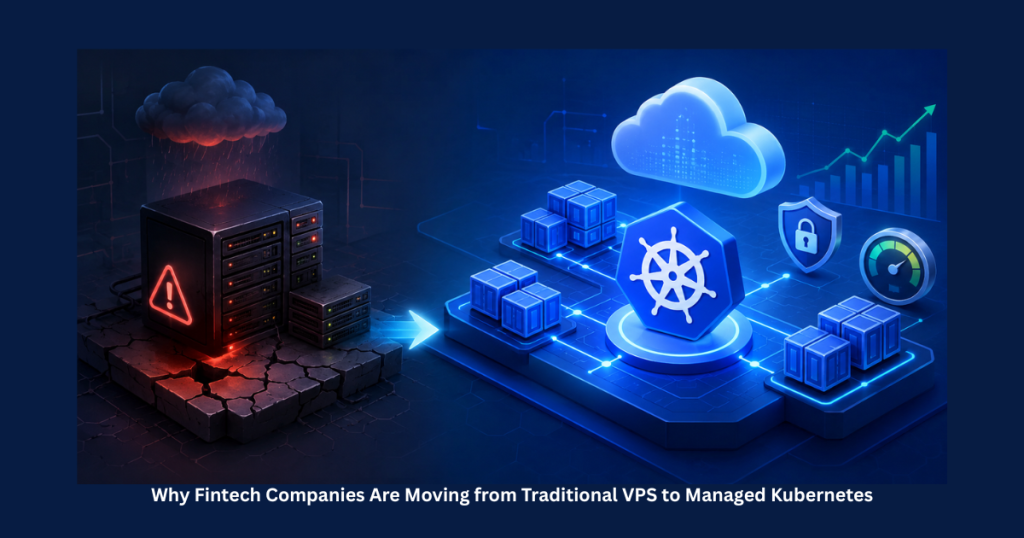
The Shift Is Already Happening
Downtime costs financial institutions millions of dollars every year. According to industry reports, the average cost of IT downtime can exceed $5,600 per minute, while digital banking users expect applications to be available 24/7.
For fintech companies handling real-time payments, digital wallets, lending platforms, and banking applications, infrastructure reliability is no longer optional. This is one of the primary reasons why organizations are rapidly moving away from traditional VPS environments and adopting Managed Kubernetes for Fintech platforms.
Managed Kubernetes for Fintech provides automated scalability, higher availability, stronger security controls, and faster deployment capabilities compared to traditional VPS environments. As fintech applications grow in complexity and transaction volume, Kubernetes enables businesses to build resilient, compliant, and cloud-native infrastructure that supports continuous innovation.
The Evolution of Fintech Cloud Infrastructure
A decade ago, deploying fintech applications on Virtual Private Servers (VPS) was considered efficient and cost-effective.
A typical architecture included:
- One or more VPS servers
- Manual scaling
- Load balancers
- Database servers
- Manual patching and maintenance
While this setup worked initially, modern fintech platforms face significantly different challenges:
- Millions of API requests
- Real-time payment processing
- Regulatory compliance requirements
- Multi-region availability demands
- Continuous deployment cycles
- Increasing cybersecurity threats
This has accelerated the adoption of modern Fintech Cloud Infrastructure built on Kubernetes.
VPS vs Kubernetes: Understanding the Difference
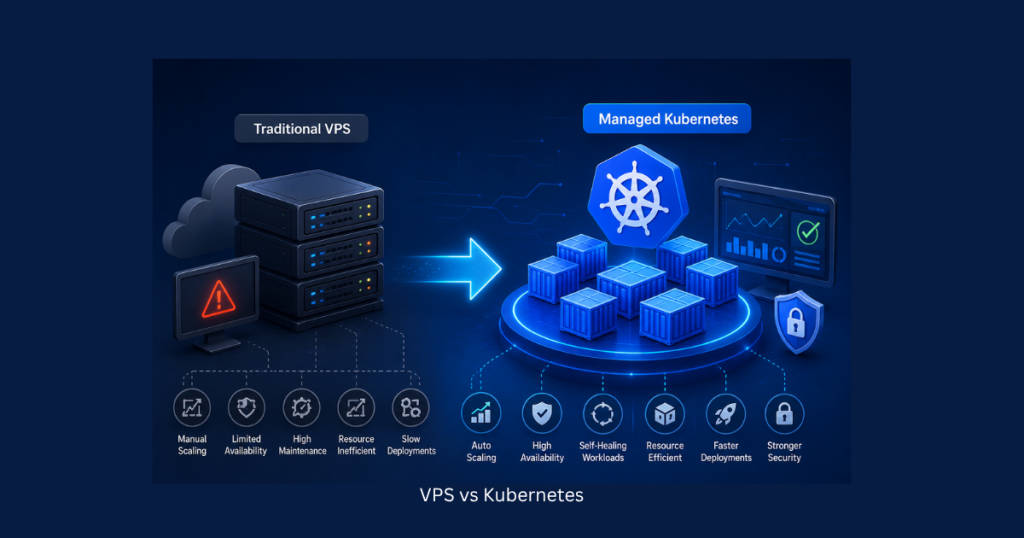
Traditional VPS Infrastructure
In a VPS environment, applications run directly on virtual machines.
Advantages
- Easy initial setup
- Lower entry cost
- Suitable for small workloads
- Simple management for basic applications
Limitations
- Manual scaling
- Resource inefficiencies
- Single points of failure
- Complex deployment processes
- Difficult disaster recovery management
As transaction volumes increase, these limitations become significant operational risks.
Kubernetes-Based Infrastructure
Kubernetes is a container orchestration platform that automates application deployment, scaling, networking, and recovery.
Instead of managing servers individually, teams manage applications as containers.
Key Benefits
- Automatic scaling
- Self-healing workloads
- High availability
- Rolling updates
- Multi-cloud compatibility
- Improved resource utilization
This is why the discussion around VPS vs Kubernetes increasingly favors Kubernetes for mission-critical fintech workloads.
Why It Matters for Fintech Companies
Fintech businesses operate in an environment where downtime, latency, and security incidents directly impact revenue and customer trust.
Common Pain Points with VPS Infrastructure
- Unexpected traffic spikes during payment peaks
- Manual scaling delays
- Infrastructure management overhead
- Slow software release cycles
- Security patching challenges
- Disaster recovery complexity
These challenges often lead to:
- Failed transactions
- Customer dissatisfaction
- Regulatory concerns
- Increased operational costs
Managed Kubernetes directly addresses these issues through automation and resilience.
Key Benefits of Managed Kubernetes for Fintech Companies
1. Automatic Scalability During Transaction Surges
Financial applications often experience unpredictable traffic patterns.
Examples include:
- Salary payment days
- Shopping festivals
- Tax filing deadlines
- Stock market events
Kubernetes automatically scales application instances based on demand.
Instead of provisioning additional VPS servers manually, workloads expand and contract dynamically.
Real-World Example
A digital payment platform processing thousands of transactions per second can automatically add container replicas during traffic spikes and reduce resources when demand drops.
This improves performance while controlling cloud costs.
2. Improved Availability and Business Continuity
Financial services require near-continuous uptime.
Modern Kubernetes platforms can distribute workloads across:
- Multiple availability zones
- Multiple regions
- Multiple cloud providers
If one node fails, Kubernetes automatically recreates workloads elsewhere.
This significantly reduces service interruptions.
Industry studies show organizations using container orchestration platforms often achieve higher application availability than traditional VM-based deployments.
3. Stronger Kubernetes Security Controls
Security remains one of the most important reasons fintech organizations adopt Kubernetes.
Modern Kubernetes Security frameworks provide:
- Role-Based Access Control (RBAC)
- Network segmentation
- Secrets management
- Container image scanning
- Runtime threat detection
- Policy enforcement
Security Example
A fintech company can restrict database access exclusively to authorized microservices while preventing lateral movement between workloads.
This creates a stronger security posture than many traditional VPS deployments.
4. Faster Product Releases
Innovation speed is a competitive advantage in fintech.
Traditional VPS environments often require:
- Maintenance windows
- Manual deployments
- Lengthy rollback procedures
Kubernetes supports:
- CI/CD automation
- Blue-green deployments
- Canary releases
- Automated rollback mechanisms
Development teams can deploy updates more frequently with reduced operational risk.
5. Better Resource Utilization
Many VPS environments remain underutilized.
Organizations often provision excess capacity to handle peak demand.
Kubernetes optimizes resource allocation by scheduling containers efficiently across infrastructure.
Benefits include:
- Reduced cloud spending
- Higher server utilization
- Better workload density
- Improved operational efficiency
Real-World Fintech Use Cases for Kubernetes
Digital Payment Platforms
Payment processors require:
- High transaction throughput
- Low latency
- Continuous availability
Kubernetes enables scalable microservices architectures capable of handling transaction surges.
Digital Banking Applications
Banks are increasingly modernizing legacy applications using containers.
Benefits include:
- Faster feature delivery
- Improved resilience
- Better regulatory compliance support
Lending and Credit Platforms
Loan processing systems frequently experience variable demand.
Kubernetes helps allocate resources dynamically while maintaining performance.
Cryptocurrency and Trading Platforms
Trading applications require:
- Low latency execution
- High availability
- Rapid scaling
Managed Kubernetes provides the infrastructure flexibility necessary for these workloads.
Kubernetes Migration Strategy for Fintech Businesses
Successful adoption requires a structured approach.
A well-planned Kubernetes migration strategy for fintech businesses typically includes the following phases:
Phase 1: Infrastructure Assessment
Evaluate:
- Existing applications
- Dependencies
- Security requirements
- Compliance obligations
Phase 2: Containerization
Convert applications into portable containers.
This often involves:
- Docker image creation
- Dependency optimization
- Application modernization
Phase 3: Security and Compliance Planning
Implement:
- Access controls
- Logging
- Monitoring
- Security policies
- Compliance controls
Phase 4: Pilot Deployment
Start with non-critical workloads.
Validate:
- Performance
- Reliability
- Security
before migrating production systems.
Phase 5: Production Rollout
Gradually migrate mission-critical applications while maintaining rollback capabilities.
Best Practices for Fintech Kubernetes Deployments
To maximize success, fintech organizations should follow these proven practices:
1. Adopt a Managed Kubernetes Platform
Managed services reduce operational complexity and allow teams to focus on application innovation.
2. Implement Zero Trust Security
Apply:
- RBAC
- Network policies
- Identity-based access controls
across all workloads.
3. Enable Continuous Monitoring
Monitor:
- Performance metrics
- Security events
- Infrastructure health
- Transaction flows
in real time.
4. Automate Disaster Recovery
Establish automated:
- Backup procedures
- Recovery testing
- Multi-region failover strategies
5. Use Infrastructure as Code
Automate infrastructure deployment and configuration management for consistency and compliance.
The Future of Fintech Infrastructure
As fintech ecosystems continue expanding, traditional VPS architectures are becoming increasingly difficult to scale and secure.
Managed Kubernetes provides the foundation for:
- Cloud-native innovation
- Regulatory compliance
- High availability
- Security automation
- Operational efficiency
Organizations that modernize early gain a significant competitive advantage through faster development cycles, improved customer experiences, and stronger infrastructure resilience.
Final Verdict
The debate around VPS vs Kubernetes is no longer simply about technology preferences. It is about building a resilient, scalable, and secure foundation for financial services growth.
Modern Fintech Cloud Infrastructure demands elasticity, automation, and enterprise-grade security. This is why more organizations are embracing Managed Kubernetes for Fintech environments and developing strategic Kubernetes migration strategy for fintech businesses initiatives.
Companies that adopt Kubernetes today position themselves to handle future transaction growth, compliance requirements, and evolving customer expectations with greater confidence.
Ready to Modernize Your Fintech Infrastructure?
If your payment platform, banking application, lending system, or financial SaaS product is struggling with scaling limitations, operational complexity, or security concerns, now is the time to evaluate a Kubernetes-first strategy.
A professionally managed Kubernetes environment can help your fintech business reduce downtime, accelerate product delivery, strengthen security, and create an infrastructure foundation built for long-term growth and regulatory compliance.
Frequently Asked Questions
Fintech companies are moving to Kubernetes because it provides automatic scaling, improved security, higher availability, and faster deployment capabilities compared to traditional VPS infrastructure. Kubernetes can provide stronger security through RBAC, network policies, secrets management, image scanning, and automated security controls when properly configured. Benefits include automatic scaling, reduced downtime, stronger security, faster software releases, better resource utilization, and improved disaster recovery capabilities. The biggest challenge is application modernization and containerization, along with implementing proper security, monitoring, and compliance controls. Kubernetes improves fintech cloud infrastructure by automating operations, supporting high availability, enabling cloud-native architectures, and providing resilience for mission-critical financial applications.1. Why are fintech companies moving from VPS to Kubernetes?
2. Is Kubernetes more secure than VPS for fintech applications?
3. What are the benefits of managed Kubernetes for fintech companies?
4. What is the biggest challenge when migrating from VPS to Kubernetes?
5. How does Kubernetes improve fintech cloud infrastructure?