Introduction
Organizations running AI, fintech, big data analytics, high-frequency trading, and latency-sensitive applications are increasingly discovering that infrastructure choice can significantly impact application performance. Studies show that virtualization overhead can reduce workload efficiency, while dedicated hardware environments often deliver more predictable performance for compute-intensive applications.
Bare Metal Kubernetes vs Cloud Kubernetes
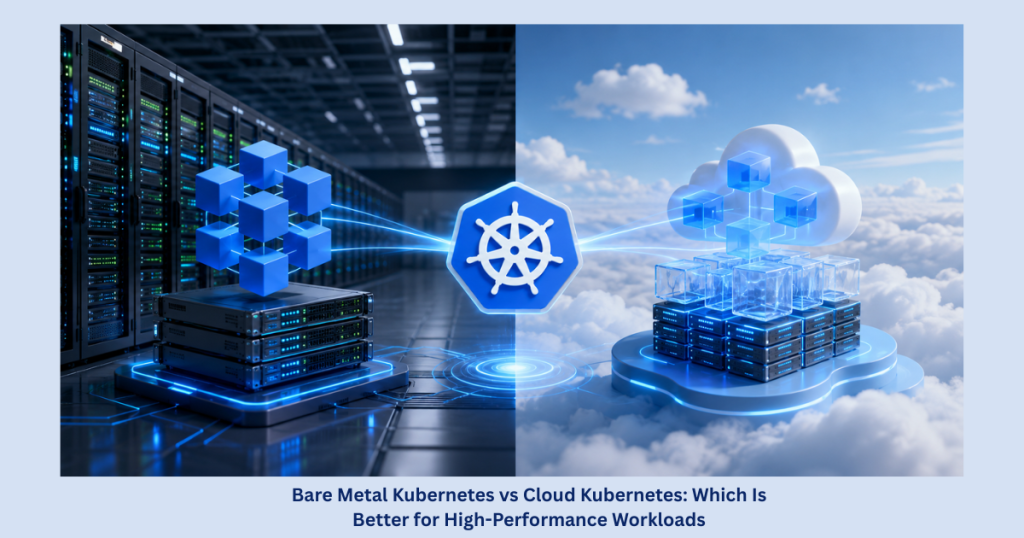
Bare Metal Kubernetes runs directly on physical servers without a virtualization layer, offering maximum performance, lower latency, and full hardware control.
Cloud Kubernetes runs on virtualized infrastructure provided by cloud vendors, offering scalability, flexibility, and simplified management.
For high-performance workloads, Bare Metal Kubernetes typically delivers better raw performance, while Cloud Kubernetes provides superior operational agility and faster deployment.
Why This Comparison Matters
As enterprises adopt Kubernetes for mission-critical applications, the debate between Bare Metal Kubernetes vs Cloud Kubernetes has become increasingly important.
The wrong infrastructure choice can lead to:
- Higher infrastructure costs
- Increased latency
- Resource bottlenecks
- Compliance challenges
- Reduced application performance
The right platform can dramatically improve workload efficiency, application responsiveness, and infrastructure utilization.
What Are Bare Metal Kubernetes?
Bare Metal Kubernetes is a Kubernetes cluster deployed directly on physical servers without a hypervisor or virtualization layer.
In this model:
- Kubernetes nodes run on dedicated hardware
- Applications access CPU, memory, and storage directly
- No virtual machine overhead exists
- Organizations maintain complete hardware control
Key Characteristics
- Direct hardware access
- Maximum CPU utilization
- Predictable latency
- Custom networking configurations
- Better storage performance
This makes Bare Metal Kubernetes for High-Performance Workloads a preferred choice for organizations requiring maximum efficiency.
What Are Cloud Kubernetes?
Cloud Kubernetes refers to managed or self-managed Kubernetes clusters running on cloud infrastructure.
Examples include:
- Amazon Web Services Elastic Kubernetes Service (EKS)
- Microsoft Azure Azure Kubernetes Service (AKS)
- Google Cloud Google Kubernetes Engine (GKE)
These platforms abstract infrastructure management and provide built-in scalability.
Key Characteristics
- Rapid deployment
- Auto-scaling
- Managed control plane
- Pay-as-you-go pricing
- Global availability
Cloud Kubernetes prioritizes operational simplicity over raw infrastructure performance.
How Kubernetes Performance Is Affected by Infrastructure
Understanding performance requires examining where workloads consume resources.
How It Works
When a Kubernetes pod receives a request:
- The request enters the network layer.
- Kubernetes routes traffic to a node.
- The node allocates CPU and memory resources.
- Storage operations are performed.
- Results are returned to the user.
Performance bottlenecks typically occur in:
- CPU scheduling
- Storage I/O
- Network latency
- Resource contention
- Virtualization overhead
This is where the Kubernetes Performance Comparison becomes critical.
Bare Metal Kubernetes vs Cloud Kubernetes Performance Comparison
| Factor | Bare Metal Kubernetes | Cloud Kubernetes |
| CPU Performance | Excellent | Good |
| Network Latency | Very Low | Moderate |
| Storage IOPS | Highest | Variable |
| Predictability | Excellent | Moderate |
| Scalability | Manual/Automated | Highly Automated |
| Hardware Control | Full Control | Limited |
| Multi-Region Deployment | Complex | Easy |
| Operational Simplicity | Lower | Higher |
| Cost Efficiency at Scale | Better | Variable |
| Deployment Speed | Moderate | Fast |
Winner for Performance
For pure compute-intensive workloads, Bare Metal Kubernetes usually outperforms cloud-based deployments.
Winner for Agility
For rapid growth and dynamic scaling, Cloud Kubernetes remains the stronger option.
Key Performance Metrics: Bare Metal vs Cloud
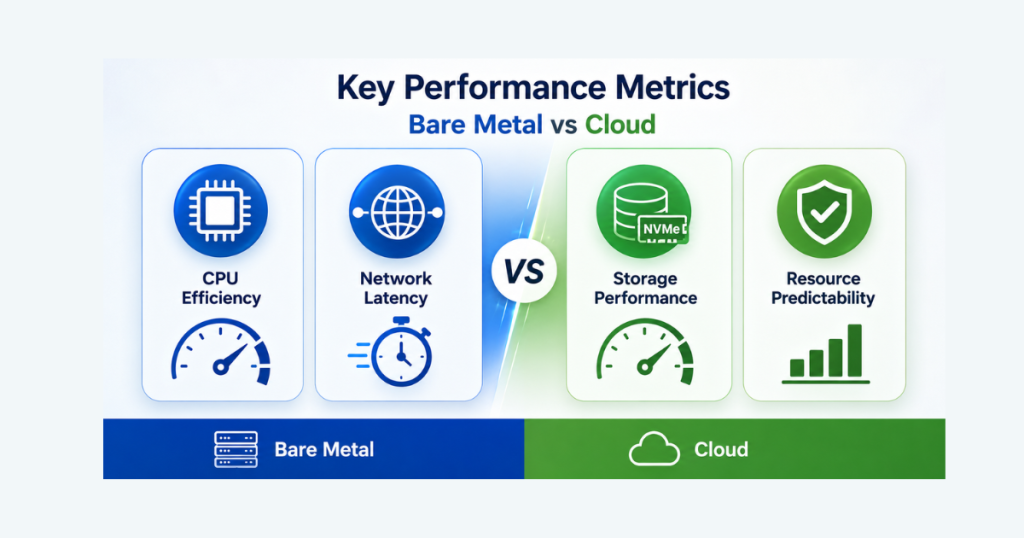
1. CPU Efficiency
Virtualization introduces overhead.
In bare metal environments:
- Applications access hardware directly.
- CPU cycles are dedicated to workloads.
- Context switching is reduced.
Many enterprise benchmarks show performance gains ranging between 5% and 20% depending on workload characteristics.
2. Network Latency
Latency-sensitive applications benefit significantly from bare metal.
Examples include:
- Payment gateways
- Trading platforms
- Real-time analytics
- Gaming infrastructure
A few milliseconds can impact transaction speed and user experience.
3. Storage Performance
Storage-intensive workloads often favor bare metal.
Examples:
- Databases
- AI training systems
- Data warehouses
- Machine learning pipelines
Dedicated NVMe storage can deliver millions of IOPS with minimal latency.
4. Resource Predictability
Cloud environments use shared infrastructure.
This may lead to:
- Noisy neighbor effects
- Variable storage performance
- Network congestion
Bare metal provides dedicated resources and predictable application behavior.
Real-World Use Cases
Fintech Platforms
High-volume payment processors often choose Bare Metal Kubernetes because:
- Transaction latency matters
- Regulatory compliance is critical
- Performance consistency is essential
For example, payment switching systems handling thousands of TPS (Transactions Per Second) benefit from dedicated infrastructure.
AI and Machine Learning
GPU-intensive AI training workloads frequently use bare metal clusters because:
- Direct GPU access improves efficiency
- Reduced virtualization overhead
- Faster model training
This is one reason many AI providers deploy Kubernetes on dedicated hardware.
SaaS Platforms
Most SaaS companies prefer Cloud Kubernetes because:
- Faster deployment
- Global scalability
- Reduced operational burden
- Managed services
For rapidly growing businesses, cloud-native Kubernetes often accelerates time-to-market.
Best Kubernetes Platform for High-Performance Computing
The answer depends on workload priorities.
Choose Bare Metal Kubernetes If You Need:
- Maximum CPU performance
- Ultra-low latency
- High IOPS storage
- GPU-intensive workloads
- Predictable performance
- Regulatory control
Choose Cloud Kubernetes If You Need:
- Rapid scaling
- Multi-region deployment
- Managed operations
- Faster provisioning
- Reduced infrastructure management
For HPC environments, AI clusters, and large-scale analytics, Bare Metal Kubernetes is generally considered the Best Kubernetes Platform for High-Performance Computing.
Best Practices for High-Performance Kubernetes Deployments
1. Use Dedicated NVMe Storage
High-speed local storage reduces application latency significantly.
2. Optimize Kubernetes Networking
Implement:
- Cilium
- Calico
- SR-IOV networking
to reduce network overhead.
3. Implement Resource Requests and Limits
Prevent resource contention by properly defining:
- CPU requests
- CPU limits
- Memory allocation
4. Use Node Affinity
Schedule critical workloads on optimized hardware.
5. Monitor Continuously
Track:
- CPU utilization
- Memory consumption
- Network latency
- Disk IOPS
using enterprise observability tools.
Future Trends: Where Kubernetes Infrastructure Is Heading
Several trends are shaping the future of Kubernetes for High-Performance Workloads.
Hybrid Kubernetes
Organizations are increasingly combining:
- Bare metal for performance-critical workloads
- Cloud Kubernetes for scalability
This hybrid approach offers the best of both worlds.
AI-Optimized Kubernetes
GPU-native Kubernetes clusters are becoming standard for AI and machine learning.
Edge Kubernetes
Low-latency applications are driving Kubernetes deployments closer to users through edge computing.
Platform Engineering
Organizations are simplifying Kubernetes operations through internal developer platforms while maintaining performance optimization.
Final Verdict
The Bare Metal Kubernetes vs Cloud Kubernetes performance comparison ultimately comes down to your workload requirements.
If your priority is raw performance, predictable latency, storage throughput, and hardware control, Bare Metal Kubernetes is the clear winner.
If your priority is scalability, deployment speed, operational simplicity, and global reach, Cloud Kubernetes offers unmatched flexibility.
The most successful enterprises are increasingly adopting a hybrid strategy running mission-critical workloads on bare metal while leveraging cloud Kubernetes for elasticity and business agility.
Ready to Maximize Kubernetes Performance?
Whether you’re running fintech applications, AI workloads, high-traffic SaaS platforms, or mission-critical enterprise systems, choosing the right Kubernetes architecture can dramatically improve performance, reduce infrastructure costs, and increase application reliability. A professionally designed Kubernetes platform tailored to your workload characteristics can unlock the full potential of your infrastructure while ensuring long-term scalability and operational excellence.
Frequently Asked Questions:
The primary difference is that Bare Metal Kubernetes runs directly on physical servers without virtualization, while Cloud Kubernetes runs on virtualized cloud infrastructure. For high-performance workloads such as AI, fintech, and big data analytics, Bare Metal Kubernetes typically delivers lower latency, higher CPU efficiency, and more predictable performance. When comparing Bare Metal Kubernetes vs Cloud Kubernetes for AI workloads, Bare Metal Kubernetes often performs better because it provides direct access to GPUs, minimizes virtualization overhead, and improves training speed for machine learning models. Cloud Kubernetes remains beneficial for rapid scaling and global deployment. For organizations running constant high-performance workloads, Bare Metal Kubernetes can be more cost-effective because dedicated hardware avoids recurring cloud compute costs. However, Cloud Kubernetes may reduce operational expenses through managed services and automated scaling. Fintech applications require low latency and consistent performance. In a Bare Metal Kubernetes vs Cloud Kubernetes performance comparison, bare metal environments generally provide faster transaction processing, predictable resource allocation, and better compliance control, making them ideal for payment gateways and financial platforms. The best Kubernetes platform for high-performance computing depends on workload requirements. Bare Metal Kubernetes is typically preferred for HPC, AI training, scientific simulations, and real-time analytics due to superior CPU, storage, and networking performance, while Cloud Kubernetes excels in scalability and operational flexibility.1. What is the difference between Bare Metal Kubernetes and Cloud Kubernetes for high-performance workloads?
2. Which is better for AI and machine learning: Bare Metal Kubernetes or Cloud Kubernetes?
3. Is Bare Metal Kubernetes more cost-effective than Cloud Kubernetes at scale?
4. How does Bare Metal Kubernetes vs Cloud Kubernetes performance comparison impact fintech applications?
5. What is the best Kubernetes platform for high-performance computing environments?