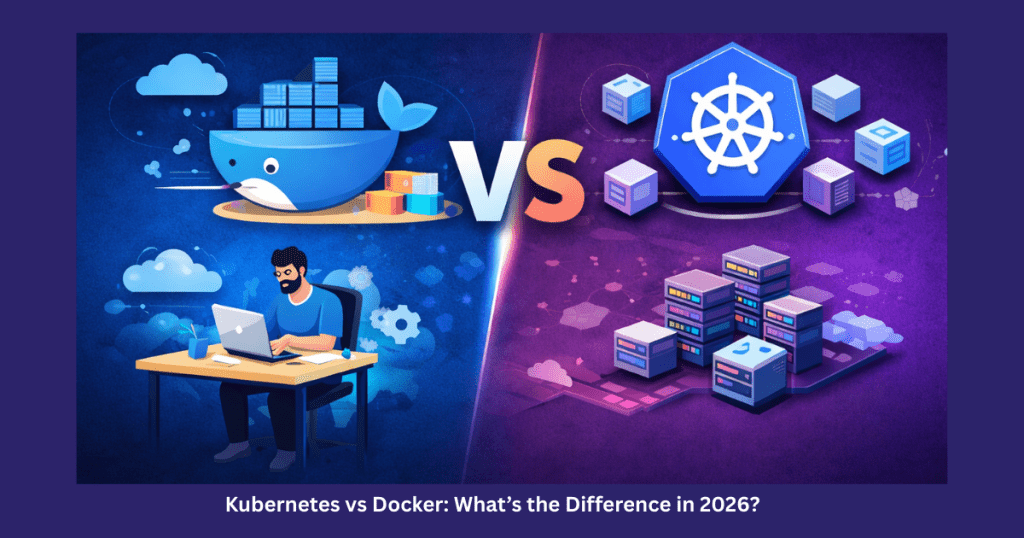
Kubernetes vs Docker is not a competition between equals. Docker is a containerization technology, while Kubernetes is a container orchestration platform. In 2026, Docker is primarily used to build and package containers, while Kubernetes is used to deploy, manage, scale, and secure them in production environments. Modern cloud-native architectures rely on both, often together, to support scalable, resilient applications across industries like fintech, SaaS, healthcare, and e-commerce.
Introduction
If you work in cloud computing, DevOps, or modern application development, you’ve probably heard the debate: Kubernetes vs Docker.
But here’s the truth in 2026: this is no longer a “vs” conversation.
Docker and Kubernetes solve different problems and most production-grade systems use both. Yet confusion still exists, especially among businesses planning cloud migrations or container adoption.
This guide breaks it down clearly, without jargon. Whether you’re a startup founder, IT manager, or DevOps engineer, this article will help you understand when to use Docker, when to use Kubernetes, and how they fit together in real-world environments.
What Is Docker?
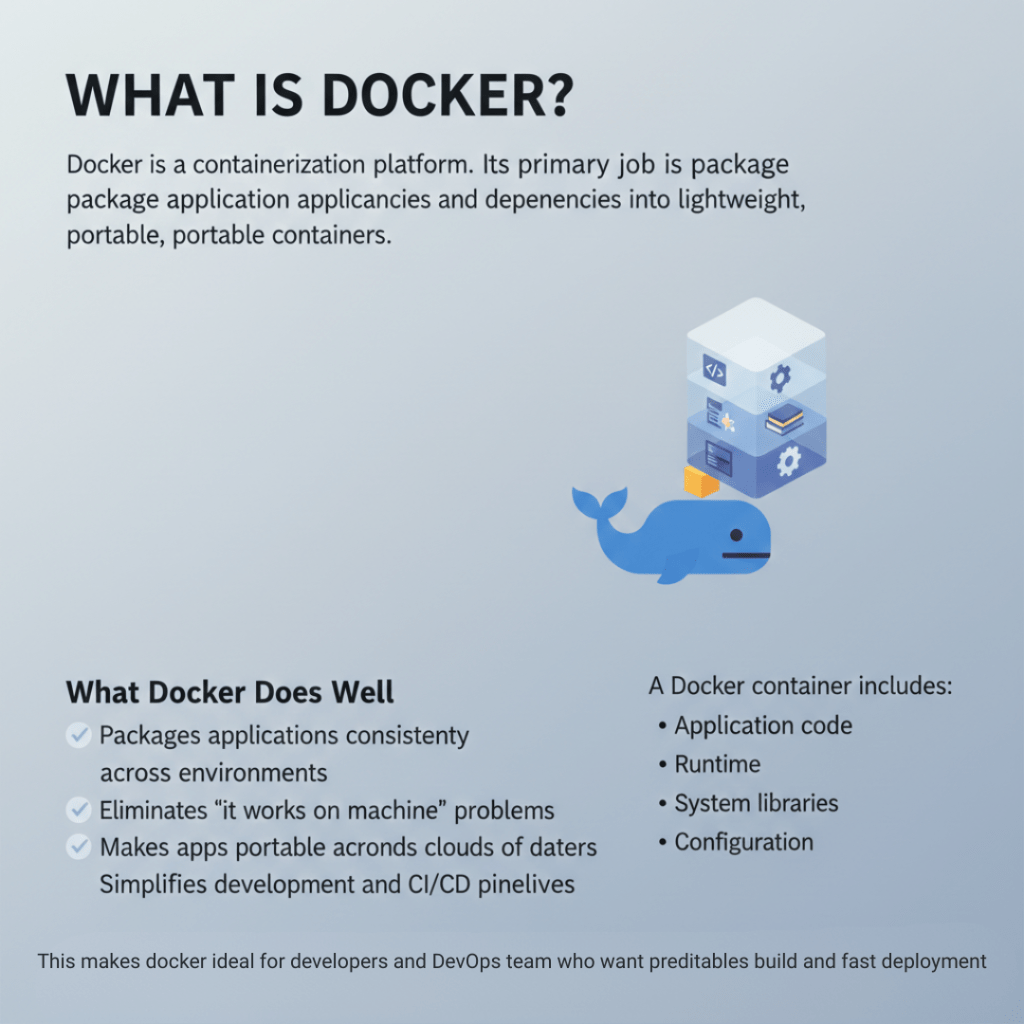
Docker is a containerization platform. Its primary job is to package applications and their dependencies into lightweight, portable containers.
What Docker Does Well
- Packages applications consistently across environments
- Eliminates “it works on my machine” problems
- Makes apps portable across clouds and data centers
- Simplifies development and CI/CD pipelines
A Docker container includes:
- Application code
- Runtime
- System libraries
- Configuration
This makes Docker ideal for developers and DevOps teams who want predictable builds and fast deployments.
Real-World Example
A SaaS startup in India might use Docker to package a Node.js application so it runs the same on a developer laptop, a QA server, and an AWS or GCP production VM.
What Are Kubernetes?
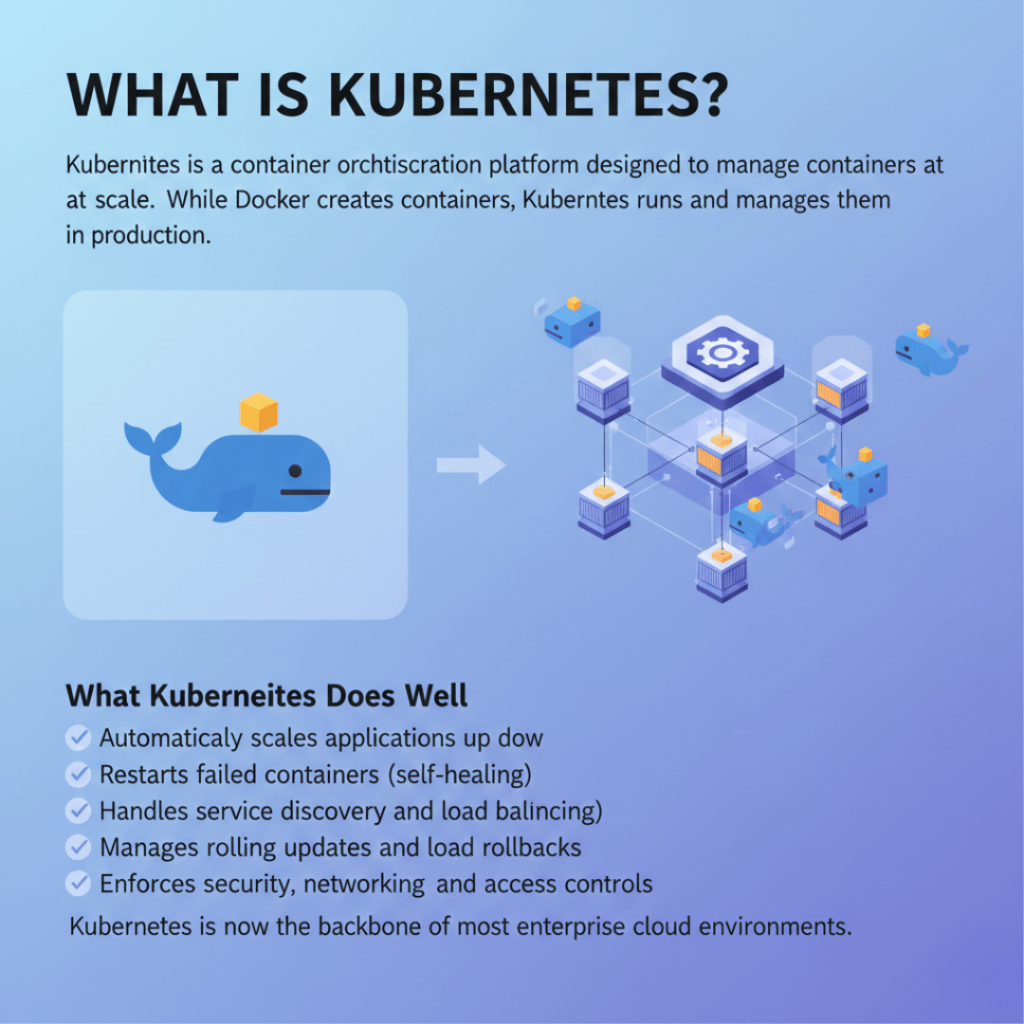
Kubernetes is a container orchestration platform designed to manage containers at scale.
While Docker creates containers, Kubernetes runs and manages them in production.
What Kubernetes Does Well
- Automatically scales applications up or down
- Restarts failed containers (self-healing)
- Handles service discovery and load balancing
- Manages rolling updates and rollbacks
- Enforces security, networking, and access controls
Kubernetes is now the backbone of most enterprise cloud environments.
Industry Usage
According to CNCF surveys, over 96% of organizations running containers use Kubernetes in production, especially in fintech, healthcare, telecom, and large SaaS platforms.
Kubernetes vs Docker: Core Differences Explained
Here’s the simplest way to understand Kubernetes vs Docker:
| Aspect | Docker | Kubernetes |
| Purpose | Create and package containers | Orchestrate and manage containers |
| Primary Users | Developers, DevOps | Platform & SRE teams |
| Scaling | Manual | Automatic |
| Self-healing | No | Yes |
| Load Balancing | Limited | Built-in |
| Production Ready | Limited alone | Yes |
Docker focuses on how to build containers.
Kubernetes focuses on how to run containers reliably at scale.
Are Docker and Kubernetes Competitors?
No — and that’s the biggest misconception.
In 2026, Docker is mostly used as:
- A container build tool
- A local development environment
- A CI/CD pipeline component
Kubernetes is used for:
- Production workloads
- Multi-cloud and hybrid environments
- High-availability systems
Most Kubernetes clusters still run Docker-built images, even though container runtimes have evolved (like containerd and CRI-O).
Docker Alone vs Kubernetes in Production
When Docker Alone Is Enough
- Small applications
- Single-server deployments
- Proof-of-concept projects
- Internal tools
Example:
A small agency running a WordPress site on a single VPS may only need Docker Compose.
When Kubernetes Is Required
- High traffic applications
- Microservices architectures
- Global user base
- Zero-downtime deployments
- Compliance-heavy industries
Example:
A fintech platform serving users across the US, Middle East, and India will typically use Kubernetes for resilience, scaling, and security.
Kubernetes vs Docker in 2026: What Has Changed?
Several things have evolved:
1. Cloud-Native Is the Default
Major cloud providers (AWS, Azure, GCP) now center their platforms around Kubernetes-based services like EKS, AKS, and GKE.
2. Docker Desktop Is Developer-Focused
Docker has intentionally shifted toward being a developer experience tool, not a production orchestrator.
3. Kubernetes Is Easier Than Before
Managed Kubernetes services have reduced operational complexity, making adoption easier even for mid-sized companies.
Performance and Scalability Comparison
In Kubernetes vs Docker, Kubernetes clearly wins for scalability.
- Docker alone requires manual scaling
- Kubernetes automatically scales pods based on CPU, memory, or custom metrics
- Kubernetes supports multi-region deployments
For example, an e-commerce platform during a Diwali or Black Friday sale can auto-scale Kubernetes workloads to handle traffic spikes — something Docker alone cannot do reliably.
Security Considerations
Security is a major differentiator in Kubernetes vs Docker.
Docker Security
- Container isolation
- Basic image scanning (with add-ons)
Kubernetes Security
- Role-based access control (RBAC)
- Network policies
- Secrets management
- Pod security standards
- Integration with enterprise IAM
In regulated industries like healthcare and payments, Kubernetes is almost mandatory.
Cost Implications
Docker is inexpensive and simple to start with.
Kubernetes:
- Requires skilled engineers
- Needs monitoring and governance
- But reduces long-term costs through automation
For businesses in regions like India, the Middle East, and Southeast Asia, managed Kubernetes has become cost-effective compared to manual VM-based scaling.
Kubernetes vs Docker: Which Should You Choose?
The real answer: both, depending on your stage.
Choose Docker if:
- You’re early-stage
- You want faster development
- You run small workloads
Choose Kubernetes if:
- You’re scaling
- You need high availability
- You operate across regions
- You require compliance and security
Most modern companies start with Docker and evolve into Kubernetes.
Conclusion
In 2026, Kubernetes vs Docker is not about picking sides.
Docker builds containers.
Kubernetes runs them at scale.
Understanding this distinction helps businesses design better architectures, reduce downtime, and future-proof their cloud infrastructure. Whether you’re running workloads in AWS, Azure, or Google Cloud, mastering both tools is no longer optional — it’s essential.
Frequently Asked Questions
Docker is used to create containers, while Kubernetes is used to manage and orchestrate containers at scale in production environments. Yes. Kubernetes can run containers built with Docker images using runtimes like containerd or CRI-O. Yes. Docker remains essential for container creation, local development, and CI/CD pipelines. Not always. Small or single-server applications can run efficiently using Docker alone. Kubernetes is better suited for enterprise applications due to its scalability, security, and automation capabilities.1. What is the main difference between Kubernetes and Docker?
2. Can Kubernetes run without Docker?
3. Is Docker still relevant in 2026?
4. Do I need Kubernetes for small applications?
5. Which is better for enterprise applications?